
Figaro Chain History for Retailers: Why This Patterned Classic Still Moves Units
Olivier FelicioIf you have been in the jewellery business long enough, you have watched chain trends come and go, then quietly come back again with a new customer and a new storyline.
The Figaro chain is one of the rare link styles that does not just cycle; it endures. It is recognizable at a glance, easy to explain at the counter, and dependable in terms of sell-through when you stock it correctly.
At Dioro Jewellery, we see Figaro as more than a style. It is a workhorse category: strong repeat demand, clean merchandising, and a reliable upsell path from entry-level gold to statement-weight pieces.
What makes a Figaro chain a Figaro?
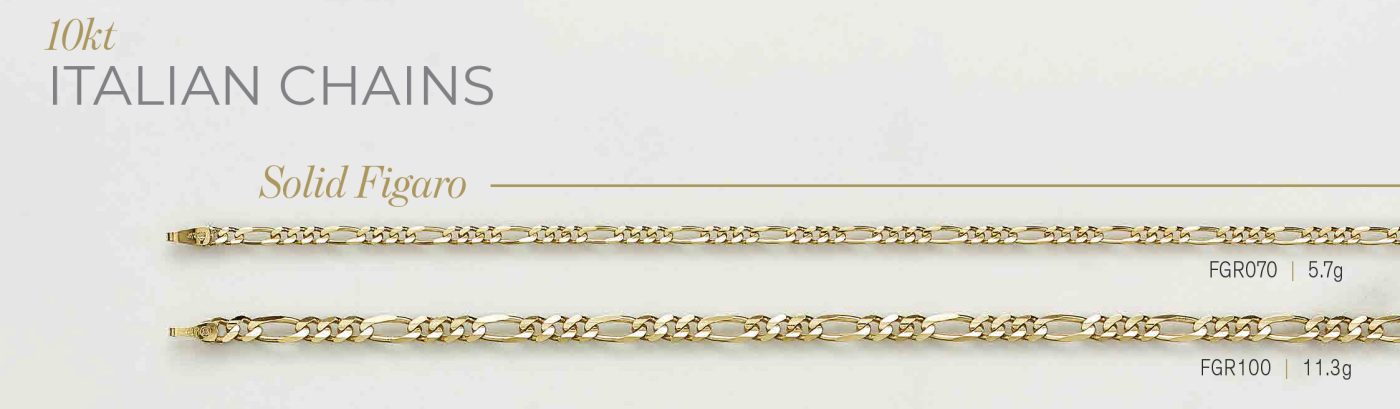
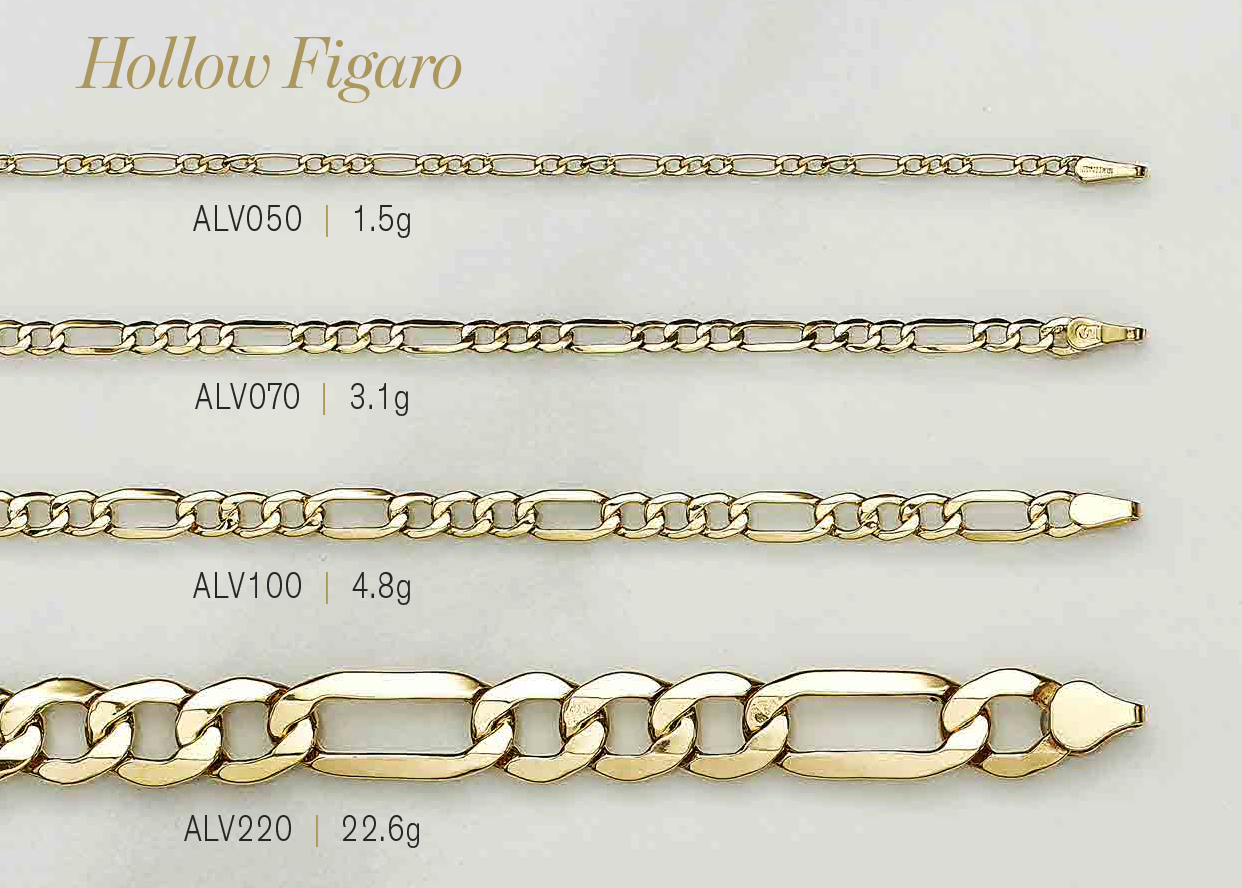
The Figaro is defined by its repeating pattern: a few short links followed by one longer link, most commonly three short, one long. That rhythm adds design without adding risk.
Customers feel like they are buying something intentional, not generic, and your sales team gets an easy feature to point to in five seconds.
Where the name comes from
The name is widely associated with Figaro, the charismatic character from classic European theatre and opera. Whether the customer knows the reference or not, the name carries European, classic, and well-made energy.
When did the Figaro chain become popular?
Chain styles do not have a single birthday. They rise through manufacturing adoption, celebrity visibility, and retail merchandising momentum.
In the 1970s and 1980s, men’s jewellery expanded into everyday wear and gold chains became a mainstream identity piece. Figaro surged because it looked bolder than a plain curb without crossing into fashion-only territory.
In the 1990s and into the early 2000s, statement chains and pendants returned strongly. Figaro benefited because it is one of the most pendant-friendly patterned chains.
Today, Figaro remains a consistent seller because it suits modern tastes for layering, gender-neutral styling, and classic with a twist.
Why Figaro still sells
It is distinctive without being polarizing. The pattern is evident, but not loud. That keeps returns low and makes it a safe recommendation for first-time gold buyers.
It sells well both solo and with pendants. Retailers win when a chain does not depend on a pendant to look finished. Figaro gives you two selling paths: wear it clean or build it with a charm.
It scales across price points. Figaro works in multiple widths and weights. That gives you a natural ladder from starter chain to statement chain.
It photographs and displays beautifully. In-store lighting, website imagery, and social selling all reward texture.
The retailer’s advantage
From a staff training perspective, Figaro is simple. The close usually comes down to three quick lines: it is a classic, it has a signature pattern, and it looks good with or without a pendant.
That simplicity matters because chains are often an add-on decision made quickly at the counter.
Smart stocking
Figaro performs best when you stock it like a program, not like a random style.
Start by building a clean ladder: one or two entry widths for daily wear, a mid-width gift and upgrade option, and one statement width that anchors your showcase and pulls the average ticket up.
Also consider how the chain is constructed. Customers may not know the difference between solid, semi-solid, and hollow, but they feel it.
Merchandising that increases sell-through
Figaro sells faster when it is not treated as just another chain. Position it as the patterned classic beside curb and rope. Show it paired with a pendant so customers can visualize the upgrade. Merchandise by width or price ladder so the progression feels natural.
One underrated tactic: keep one Figaro piece on display in a width that reads clearly from a distance. The pattern needs visibility to do its job.
A Dioro note
As a wholesaler, we are always looking at what makes sense for retailers: styles that do not just sell once, but sell repeatedly with predictable demand.
Figaro is evergreen because it bridges generations, is easy to merchandise, and supports higher-value transactions through width and weight upgrades.